
Sachse City Directory Collections
No long-running standalone Sachse city directory series was located in the official and library catalog sources. That gap is useful information. The strongest local printed trail is found in regional telephone and community books held by Dallas Public Library, not in an assumed city-only publication. A listing can offer a name, phone-era address, or route into a street guide, but it does not prove every person at an address or the exact city boundary served by that edition.
| Collection | Years | Where held | Access |
|---|---|---|---|
| Southwestern Bell regional books | 1990-91, 1993, 1998-99 | Dallas Public Library | Catalog and library research route |
| Garland, Rowlett, Sachse, Wylie book | 2005-06 | Dallas Public Library History & Archives | Regional telephone/address coverage |
| Wylie-Sachse-Murphy books | 2005, 2007-08, 2008-09 | Dallas Public Library holdings | Local name and reverse-style leads |
| Dallas directories and cross-reference books | 1873-1979, 1981-89, 1991, 1996; cross-reference through 2019 in listed runs | Dallas History & Archives | Microfilm, print, and selected online material |
Dallas proper directories are valuable for method and Dallas-side context, but they should not be presented as a complete roll of Sachse names. The catalog lists selected Garland and Dallas runs as well, which can help when a telephone exchange or an address reaches beyond the present city label.
Note: Match each result to the exact edition before deciding that a street or name was in its coverage area.
Sachse City Directory Years Nearby
The regional sequence is the practical spine for a Sachse city directory search. Southwestern Bell books list 1990-91 and 1998-99, and the catalog also identifies a 1993 run. Later books narrow closer to the community: Garland-Rowlett-Sachse-Wylie for 2005-06, then Wylie-Sachse-Murphy for 2005, 2007-08, and 2008-09. The publisher was not identified for the area-wide community books, so the title and year should be recorded exactly as shown by the library.
- Write down the street, surname spelling, and approximate year.
- Request the regional book that covers that year and area.
- Check both alphabetical and address-oriented portions when the volume includes them.
- Copy the edition title and page with any name or address lead.
The year gaps matter. A missing listing can reflect a missing edition, an unlisted phone, a different regional book, or an OCR failure. It is not enough to conclude that someone was absent from Sachse.
Sachse City Directory Shelf Access
Dallas Public Library History & Archives is at 1515 Young Street in Dallas and is a Regional Historical Resource Depository for Dallas County. Its public description includes city and telephone directories in print and microfilm, Dallas directories available through the Portal to Texas History, maps, yearbooks, newspapers, and Sanborn material. A specific request is more likely to reach the right shelf when it gives the surname or address, town, year, and record type.
This History & Archives view is the source for the collection image below.
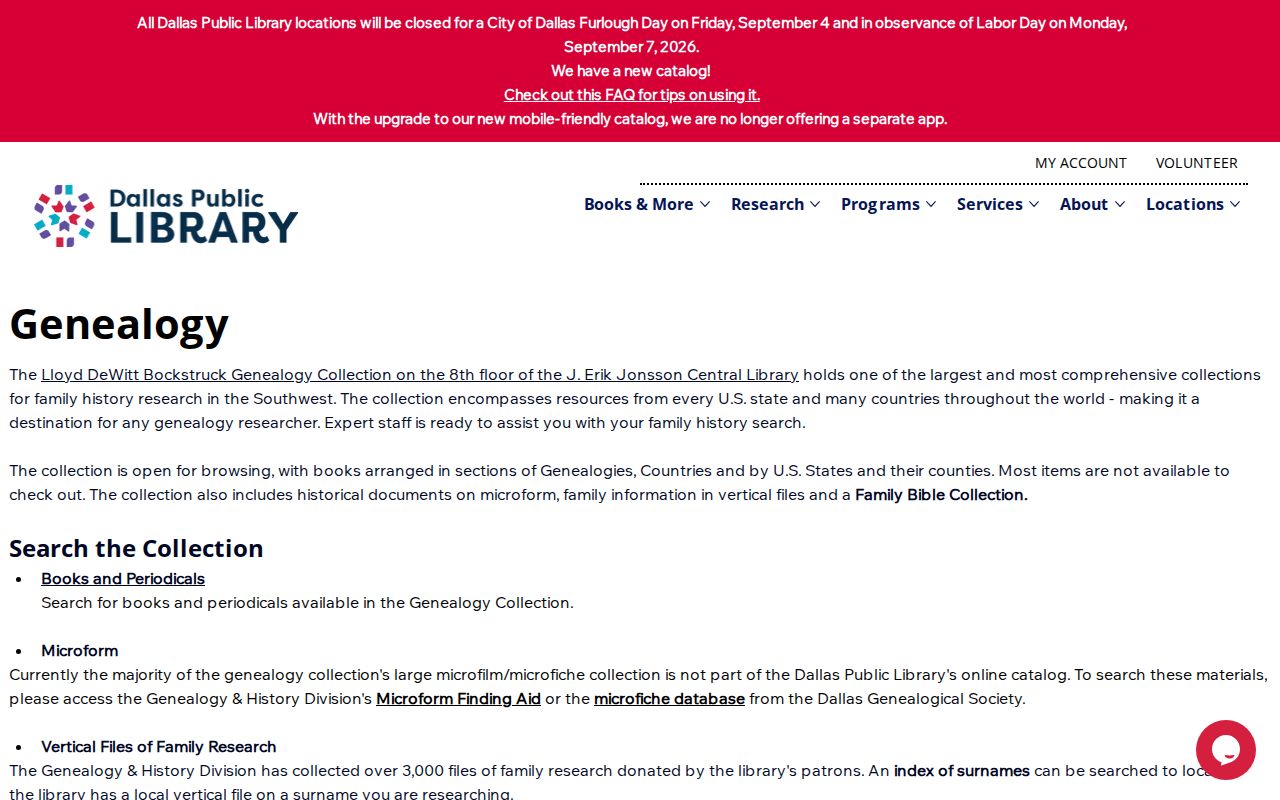
The library’s online catalog does not capture every county or city microform holding. Questions about microform can go to the library at 214-670-1433 or genealogy@dallaslibrary.org; the library also lists general History & Archives contact at 214-670-1400 and texas@dallas.gov.
History & Archives
1515 Young Street, Dallas, TX 75201
214-670-1400
texas@dallas.gov
Bockstruck Genealogy
Eighth floor, J. Erik Jonsson Central Library
Microform questions: 214-670-1433
genealogy@dallaslibrary.org
Reading a Sachse City Directory Entry
A digitized 1956 Dallas directory shows the structure that makes these books useful. The alphabetic portion may place a personal name beside a spouse or household notation, an occupation or business affiliation, and a street address. It also has business and classified sections plus a street and avenue guide. Those fields establish research leads, not current facts. Each edition has its own key, so a symbol must be read from that volume’s front matter before it is interpreted.
| Indexed name | The personal or business name used in the alphabetic section. |
|---|---|
| Household notation | A spouse or other edition-specific notation may appear in parentheses. |
| Address line | A street number and street spelling that can be checked in the guide. |
| Activity line | An occupation or business affiliation when that edition printed one. |
| Status marks | Edition-specific abbreviations that require the front-matter key. |
- Criss-cross directory
- An address-first or street-order section used to move from a location to a listed name.
- Householder index
- A name arrangement that identifies a listed household contact, not a complete count of occupants.
- Abbreviation key
- The edition’s explanation of printed marks, usually placed near the front of the volume.
The digitized 1956 Worley directory supplies the source view for the image below.
Its 2,108 scanned pages include alphabetical, business, and street-guide material. OCR can misread names, punctuation, and abbreviations, so the page image should confirm each search hit.
Sachse City Directory Newspaper Layer
When the shelf does not hold a book for a target year, the UNT Wylie-Sachse collection adds a local memory layer. It includes 3,063 items across The Wylie News, Sachse Sentinel, and Sachse News, spanning 1948-2011. The collection’s browse counts identify 2,262 Collin County items and 801 Dallas County items. Search Inside, Guided, Advanced, and Proximity modes can be used against OCR, metadata, titles, subjects, creators, and names.
UNT’s Wylie-Sachse collection page is the source for the image below.
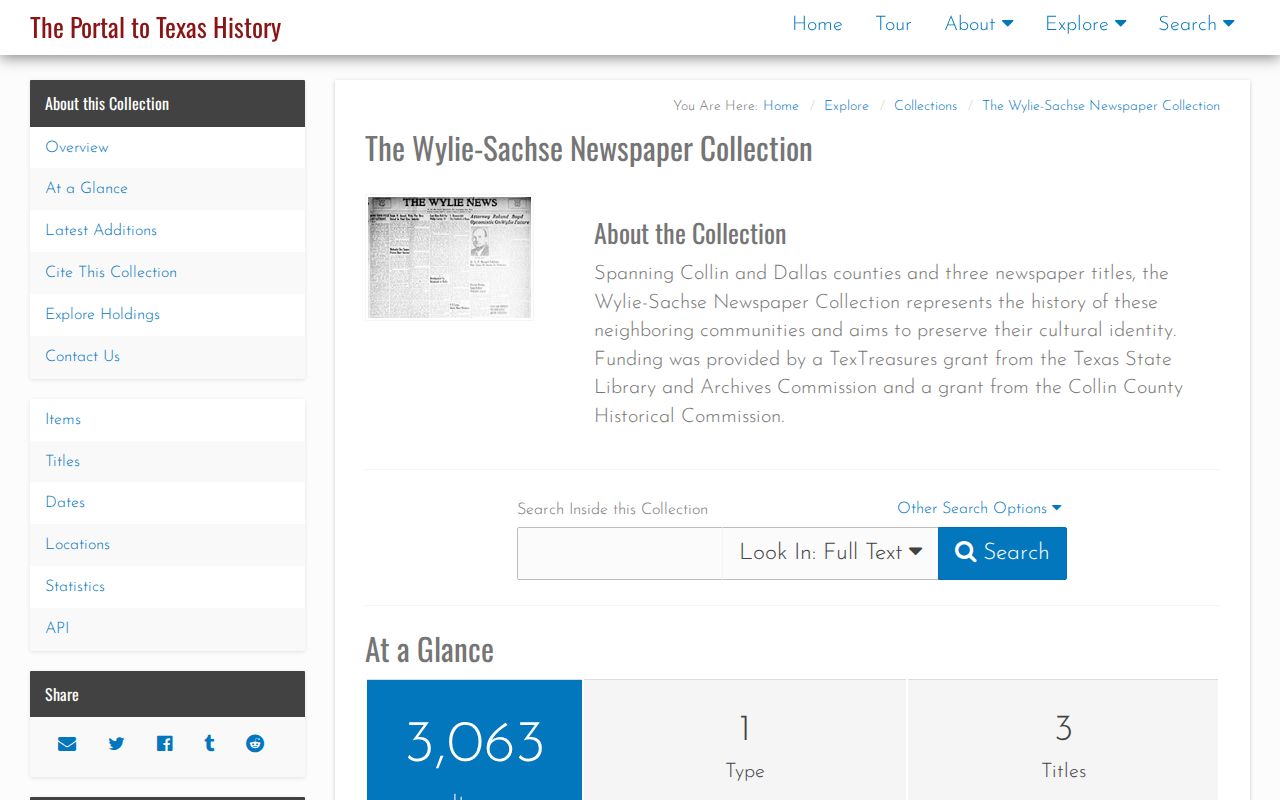
Newspaper results can connect a name or historical address to an obituary, school, civic notice, farm family, or development phase. Use alternative spellings and date terms, then confirm a useful lead against a directory scan, deed, or other primary record.
Using Sachse City Directories for Family History
A Sachse city directory trail becomes stronger when the street is fixed before names are chased across years. Record the current situs address, historic spelling, subdivision or lot and block, and likely county. Use a regional reverse book when available. Otherwise, search the alphabetic section and street guide together. The 72-year census rule matters here: public access reaches the 1950 census as of 2026, so a directory and a census answer different questions about a household.
- Find the earliest edition that could include the surname or address.
- Record the listing, page, street spelling, and all edition-specific marks.
- Check the next available regional edition for the same surname and street.
- Pair the interval with the released census year rather than treating a census as annual evidence.
- Confirm a move or disappearance with a newspaper notice, probate record, deed, or permit.
A listed subscriber is not every occupant, owner, or legal resident. For present address-keyed records, use the Sachse street directory workflow instead of extending a historical phonebook beyond its purpose.
Sachse City Directory Name Seeds
The Sachse Historical Society gallery supplies historical family-name seeds including Sachse, Herring, Bailey, Brand, Yarbrough, Ingram, Barger, Stone, Foster, Hutson, Rasure, Reed, Davis, Pyles, Sandifer, Salmon, Kirby, Burden, Himel, Stracener, Anderson, and Skinner. These names are context for searching period material. They are not a current directory or evidence of a relationship.
The Historical Society gallery is the source for this image.
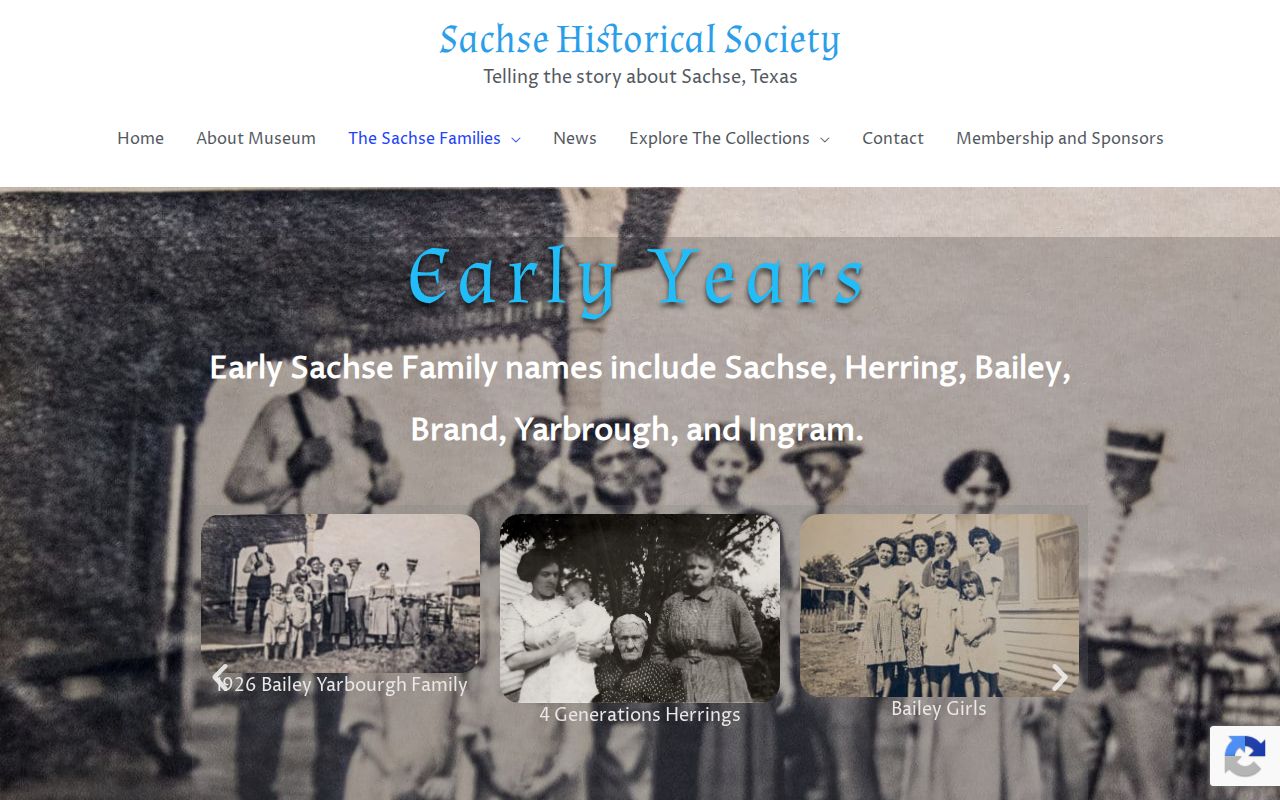
Test exact and plausible OCR variants, then compare the result with an address, obituary, deed, or directory page. The Society museum is at 3033 6th Street, open second and fourth Saturdays from 11 to 3 and by appointment, with contact at 972-496-6577 or Sachsemuseum@gmail.com.
Note: A name in a historical display is a search seed, not proof of a current connection or membership.
Sachse City Directory Local Library Route
Sachse Public Library points users to its catalog, online resources, and Wylie-Sachse news archive. It is a sensible local starting point for former classmates, yearbooks, and newspaper references when no verified standalone Sachse book exists. Dallas Public Library’s Bockstruck Genealogy Collection adds vertical files, Family Bible material, cemetery and probate resources, microform, and licensed genealogy databases. Availability and access rules differ by database.
Sachse Public Library’s public page is the source for the local-library image.
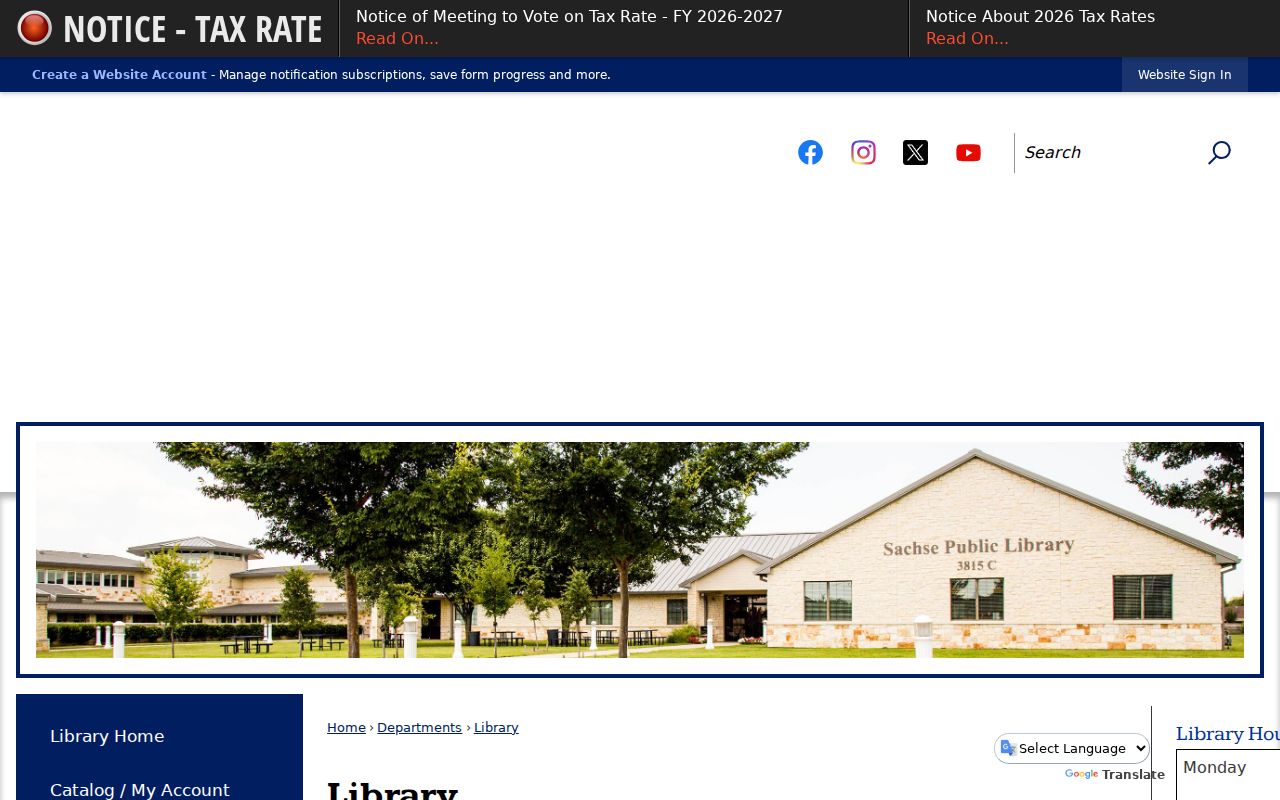
For a distant request, give the library or archive a focused target: a surname, address, year, town, and format. When no listed item appears online, a microfilm inquiry, archival request, historical society appointment, or Texas Public Information Act request for an existing municipal record can be the next documented route.
Sachse City Directory Record Eras
Sachse’s directory history follows a regional pattern because early records sit under county, farm, church, and family names. William Sachse arrived in 1840 and obtained 640 acres in Collin County; the city incorporated in 1956. Dallas County and Collin County therefore retain older series that predate municipal recordkeeping. Collin’s land-record portal offers Historical Records for 1843-1975, while Texas State Library and Archives Commission guides identify older Dallas County tax, court, naturalization, and burial material.
- 1840: William Sachse obtained 640 acres in Collin County.
- 1956: Sachse incorporated.
- 1990-99: cataloged Southwestern Bell regional directory years appear.
- 2005-09: cataloged area and Wylie-Sachse-Murphy books provide the closest located printed runs.
- 1948-2011: UNT’s digitized newspaper span supplies a searchable companion record.
No verified courthouse-loss story explains an absent Sachse record. When an online search is empty, check library microfilm, the county counter, FamilySearch, Texas State Library and Archives Commission material, or newspapers rather than assuming destruction.
Dallas County and Collin County records can also answer a question that a directory cannot. A county deed may preserve a legal description, a probate file may identify a representative, and a newspaper may date an event between available books. Keep the book title, year, page, county, and scanned image together. That small record of the search makes it possible to revisit a lead when a better catalog entry or a newly digitized issue appears.
The historical route has several access channels. Start with the online UNT collection or the library catalog, then ask History & Archives staff about a named reel or year. If the material is not in the shelf record, try the Historical Society by appointment, the county counter for an official record, or a written Texas Public Information Act request for an existing city record. Each route covers a different period and format.